
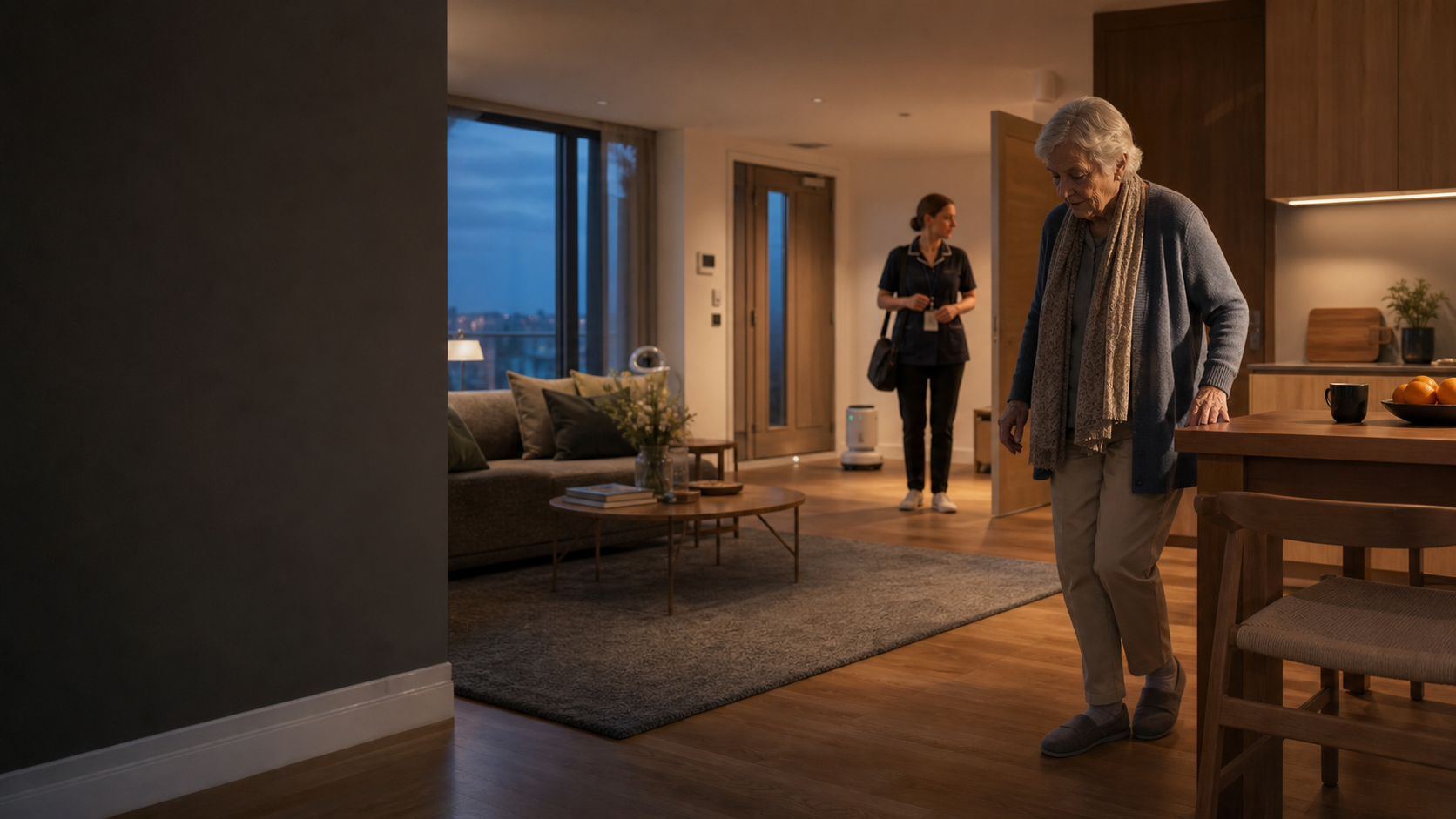
The next care technology shift is not a device. It is the environment learning how to carry context between people, systems and time—without taking over the decisions that should remain human.
Five years is closer than it sounds
Five years feels like a long horizon until you count what has already shipped in the last five. Wearables that once tracked steps now track heart rhythm continuously enough to flag arrhythmia before a person notices symptoms. Voice assistants that once set timers now hold multi-turn context across a household. Care alarms that once required a resident to press a pendant now infer a fall from a change in gait pattern picked up by ambient sensors. None of this required a breakthrough. It required the ordinary compounding of sensor cost curves, model capability, and connectivity that has been running quietly in the background since around 2019.
The home of 2031 will be built almost entirely from technology that already exists in some form today. What will change is not invention. What will change is integration, and specifically whether the pieces are allowed to see each other. That is a much closer horizon than the phrase “the future of the home” suggests, and it is why the organisations that start building the coordination layer now, rather than waiting for a defining product moment, will be the ones setting the terms when the shift becomes visible to everyone else.
From connected devices to shared context
The smart home of the last decade was an exercise in parallel play. A thermostat learned your schedule. A doorbell recognised faces. A fall sensor logged a bathroom. Each device got smarter in isolation, and each device’s intelligence stopped at its own boundary. Nothing in that generation of devices actually understood a person; each device understood a narrow slice of behaviour and reported it to an app that a human had to interpret.
The shift underway now is from isolated intelligence to shared context. A fall sensor that knows a resident has been more fatigued for three days, because a wearable reported disrupted sleep, and less mobile for two, because ambient sensors logged fewer room transitions, is answering a fundamentally different question than a fall sensor working alone. It is not asking “did a fall happen”. It is asking “is this person’s baseline shifting, and does that change what we should be watching for”. That question can only be asked by a system that holds context across devices, across time, and across the different parties who have a legitimate reason to see it. Getting there requires autonomy that does not forget what it learned yesterday, which is the argument we make in full in Autonomy Needs a Memory.
What changes inside the ordinary home
For the ordinary household, most of this will be invisible by design. Nobody wants to manage a dashboard of their own physiology. What changes is that the home starts to notice things a person would otherwise only discover in hindsight: a parent’s early signs of frailty showing up as a change in how long they take to get from kitchen to sitting room, a child’s disrupted sleep pattern correlating with a change in screen time that nobody had consciously connected, a household member’s medication adherence quietly tracked without turning the kitchen into a clinical environment.
The ordinary home in 2031 will not look futuristic. It will look like the same rooms, the same furniture, the same routines, with an environment underneath that can answer questions when asked and raise a flag when something matters, rather than a household that only finds out something was wrong after an ambulance arrives.
The ordinary home in 2031 will not look futuristic. It will know when to speak—and when to stay quiet.
What changes inside the care home
Inside the care home, the shift is more structural because the stakes and the regulatory obligations are higher. Care homes today run on a mixture of paper logs, handover notes, and disconnected point solutions for falls, medication, and nutrition, stitched together by staff who are already stretched. The coordinated environment does not replace the care plan. It makes the care plan live, continuously informed by what is actually happening in the building rather than reconstructed retrospectively from a shift handover.
This means a resident’s evening restlessness showing up automatically against their known dementia care plan rather than requiring a night carer to remember and report it manually. It means a change in a resident’s eating pattern being visible to a dietitian before weight loss becomes clinically significant. It means an inspector, a family member, or a safeguarding lead being able to reconstruct exactly what happened around an incident, not from memory, but from a governed evidential record. None of this is about replacing carers with sensors. It is about giving the people already doing the work a building that tells the truth continuously instead of a filing cabinet that tells the truth in arrears.
The evolving role of carers, families and residents
The professional carer’s role does not shrink in this model. It changes shape. Less time goes into manually observing and logging routine state, because the environment does that continuously. More time becomes available for the judgement calls that only a human should make: how to approach a resident who is anxious, how to have a difficult conversation with a family, how to weigh a resident’s stated wish for independence against a genuine safety risk. The environment’s job is to make sure the carer has the right information at the right moment, not to make the decision for them.
Families move from being occasional visitors reliant on secondhand updates to being a governed party with permitted, contextual visibility into a relative’s wellbeing, appropriate to their role and consented by the resident wherever the resident has capacity to consent. Residents themselves, particularly in supported and assisted living settings rather than high-dependency care, gain something that is often missing from institutional care today: a system that supports their independence by default and only escalates to human intervention when the evidence actually warrants it, rather than a model of care built around constant supervision because nothing else was trusted to notice.
Where agents and robots genuinely help
The honest answer is: in the narrow, repetitive, physically or cognitively demanding tasks that currently consume disproportionate carer time and deliver little of the relational value that residents and families actually want from care. Reminders delivered consistently and without judgement. Physical assistance with mobility and transfers, reducing injury risk for both resident and carer. Environmental monitoring that runs continuously without fatigue. Coordination tasks, like making sure a GP referral, a medication change, and a family update all reflect the same current picture, that currently fall through the cracks between systems that do not talk to each other.
Where agents and robots do not help, and should not be positioned as helping, is in replacing the relational and judgement-based core of care. A robot that reminds someone to take medication is useful. A robot substituting for the conversation a lonely resident actually needs is not care, it is an alibi for under-resourcing care, and any serious builder in this space needs to be honest about that distinction rather than blurring it in a product demo.
Why memory, governance and evidence become essential
None of the previous six sections work without three things holding underneath them, and they are not optional extras bolted on for compliance. The first is memory: a system that can only see the present moment cannot tell you that someone’s baseline is shifting, because a shift can only be detected against a remembered history, which is why autonomy needs a memory in the first place, not as an engineering nicety but as the precondition for everything described above.
The second is governance. A home that holds continuous context on a resident’s health, mobility, and behaviour is holding something that must be permitted, not merely collected. Who is allowed to see what, under what condition, for how long, and revocable by whom, has to be a property of the system’s design, not a policy document nobody reads. That is the argument made in full in Memory Needs Governance, and it is not a secondary concern to the technology described here. It is the thing that determines whether any of it is trustworthy enough to deploy in a person’s home at all.
The third is evidence. When something goes wrong, and in care environments something eventually will, the question that follows is always the same: what happened, in what order, and who knew what, when. A coordinated environment that cannot reconstruct its own decisions and the outcomes that followed is not an asset in that moment, it is a liability, regardless of how sophisticated its sensors were. This is the argument behind Action Needs Evidence, and it is the difference between a system that supports an inquiry and a system that becomes the subject of one.
What must remain human
Consent, wherever a resident retains the capacity to give it. The decision to escalate a genuine safeguarding concern. The conversation that tells a family their relative’s condition has changed. The judgement about when independence is worth a small increase in risk, and when it is not. The apology when something goes wrong. None of this should be automated, and no responsible builder in this category should be trying to automate it. The coordinated environment’s entire value proposition is that it clears the operational noise away from these moments so that a human being can be fully present for them, not that it takes them over.
What needs to be built now
The gap between the home described above and the home that exists today is not primarily a hardware gap. Sensors, wearables, and basic robotics are largely available and improving on their own trajectory regardless of what any single organisation does. The gap is the coordination layer: a governed context model that can hold a person’s evolving state across devices, across time, and across the different humans and systems that have a legitimate reason to act on it, with memory, permissioned governance, and evidential reconstruction built in from the start rather than retrofitted after an incident forces the question. That is infrastructure work, not product work, and it needs to be built before the device layer matures further, not after, because retrofitting governance onto an ungoverned installed base of sensors is materially harder than designing it in from the first deployment.
A day in the home of 2031
A wearable notices a resident’s resting heart rate is slightly elevated compared with their two-week baseline, logs it without alarm, and quietly raises the threshold for what would count as concerning later in the day. A carer arriving for the morning visit sees this as one line of context, not a separate alert, folded into the handover they already read.
Ambient sensors note the resident has taken longer than usual to move between rooms; nothing is triggered, because the system has learned this happens on days following disrupted sleep and treats it as expected variation rather than an event.
A family member checks in through a permissioned view appropriate to their role, sees that things are stable, and does not need to call the care home to ask, because the information they are entitled to see is already visible to them in context.
The resident, still living independently in assisted housing, forgets an evening medication; a gentle reminder handles it without any human involvement, and it is logged, not escalated, because a single missed dose against an otherwise consistent pattern does not warrant it.
A genuine change occurs—a fall—detected within seconds by the same ambient system that spent the day staying quiet. This time it does escalate, immediately, to a human, with the preceding context already assembled so the responding carer is not starting from zero.
Nothing in that day replaced a human decision that mattered. Everything in that day removed the noise that would otherwise have buried the moment that did.
WHERE TO BEGIN
Start beneath the device.
If you are building toward any part of this environment, the place to start is not the sensor or the robot. It is the governed context model underneath them.
Where do I start?