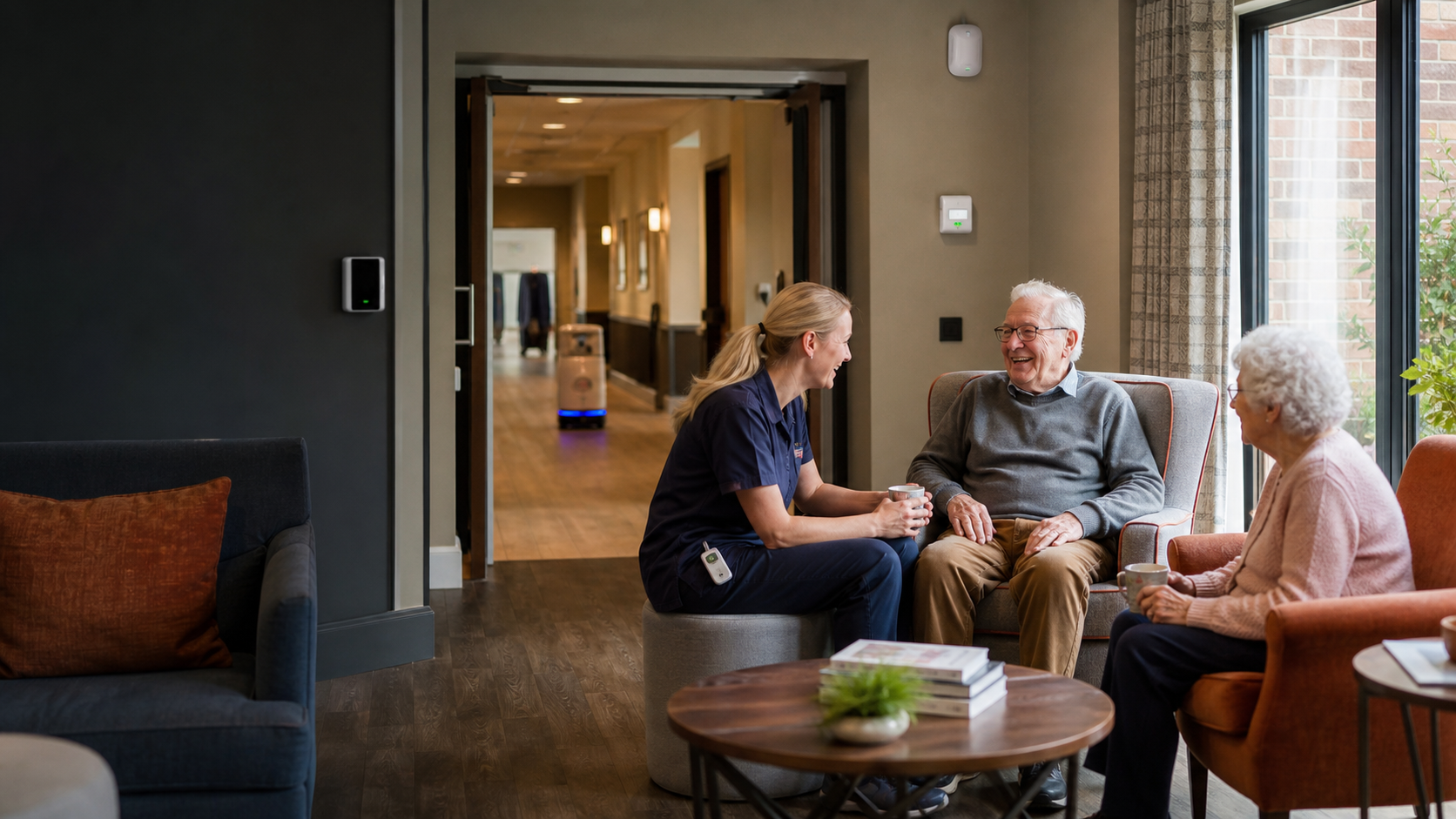
Care already moves between residents, families, shifts, providers, homes and systems. Connected devices and robots add more signals and more possible actions. The result needs more than another application: it needs a governed operating layer for Care context.
The central problem is continuity. A note can be written, a workflow routed, a sensor triggered and a robot instructed. But care depends on knowing who an event concerns, whether the context is current, which source has authority, what consent and policy apply, who needs to know and what evidence must remain.
Why The Category Exists
Care homes, care at home, hospitals and community settings already use records, alarms, wearables, appliances, sensors and automation. Voice agents and robots will join them. Each can create useful signals; the risk is that each owns a separate fragment of the person's context.
Fragmented context is awkward in ordinary software. In care, it becomes a governance problem. Resident identity, medication exceptions, observations, routines, family communication, permissions and handovers cannot be treated as local application state.
What Care Context Has To Hold
Care context infrastructure should help an authorized person or system answer practical questions before a notice is sent or an action is taken:
- Who is this event about?
- Is the context current, stale or disputed?
- Which source is authoritative for this fact?
- Who is allowed to see or act on this information?
- Does the situation require human review?
- What evidence supports the output?
- Can the context survive a new shift, provider, application, device, robot or care setting?
Where Octeryx OS Fits
Octeryx OS Care is the Care-facing product: one context operating system across care home groups, individual care homes and the private home.
Signals enter from authorized people, care systems, devices, sensors and robots. Identity is resolved, relevant context is compiled, consent and policy are evaluated, notices or bounded actions are routed, and receipts and evidence are retained. Human care-decision ownership remains explicit.
What It Does Not Claim
Octeryx OS is in active R&D. Public materials should describe the current stage as accepted Care-only product architecture, typed contracts, deterministic repository proof and bounded role-shaped surfaces. It should not be described as live clinical deployment, regulatory approval, certified operation or autonomous care decision-making.